
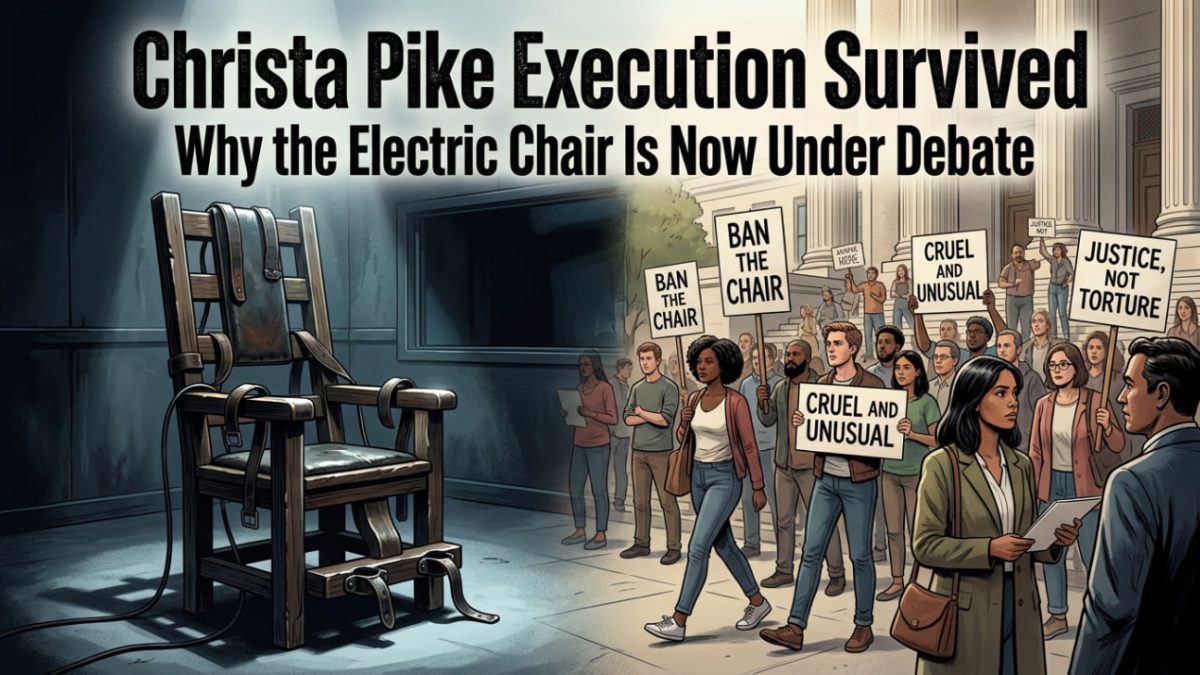
Christa Pike Execution Survived: Why the Electric Chair Is Now Under Debate

 Trial & Death Row
- Christa Pike survived a botched lethal injection in Tennessee after executioners failed to establish viable intravenous access.
- Governor Bill Lee suspended executions through the year as an independent investigation began into the botched procedure.
- Officials are now debating whether to pursue a second execution via the electric chair or commute Pike's sentence to life.
Surviving an execution attempt does not grant automatic freedom, and Pike remains under a valid death sentence. Tennessee officials are debating whether to commute her sentence or seek a second execution date using the electric chair or lethal injection.
Was this useful? Share your thoughts in the comments
 Hot right now
Inside Christa Pike’s Tennessee Death Row Cell Confinement After Halted Execution
After surviving a failed lethal injection where executioners administered two doses of pentobarbital and stuck her with needles at least seven times, 50-year-old death row inmate Christa Pike is recovering under guard while Tennessee officials confront an unprecedented legal dilemma: pursue a second execution using the electric chair or commute her sentence entirely. The procedure at Riverbend Maximum Security Institution left Pike hospitalized with severe arm trauma, cognitive deficits, and life-threatening complications, sparking immediate calls from political figures to reconsider electrocution while state defense attorneys prepare constitutional challenges.
The failure marks the first time an inmate sentenced to death in the United States has survived a lethal injection, according to Robin Maher of the Death Penalty Information Center. With state executions officially suspended through the remainder of the year by Tennessee Governor Bill Lee, the botched procedure has exposed structural breakdowns within the Tennessee Department of Correction, prompting the resignation of the agency’s commissioner and triggering an independent third-party investigation.
The Botched Lethal Injection and Pike’s Medical Reality
Pike was convicted for the 1995 torture and killing of 19-year-old classmate Colleen Slemmer in Knoxville, a crime committed when Pike was 18 years old. Scheduled to become the first woman put to death by Tennessee in more than two centuries, the procedure collapsed when medical personnel repeatedly failed to secure viable intravenous access. Pike was subjected to prolonged needle insertions before receiving two distinct doses of the sedative pentobarbital, neither of which proved fatal.
Rather than dying, Pike sustained systemic trauma that required emergency hospitalization. Defense attorney Stephen Ferrell confirmed that Pike has since begun taking limited steps around her hospital room, though her arms remain severely damaged with restricted functionality. Medical recovery has been compounded by severe conditions, including pneumonia and a blood clot, alongside noticeable cognitive impairment.
“The problem is, in prison when trying to kill her, that’s a punishment. Now she’s like any other civilian, you have an obligation to keep people alive.”
Because Pike experiences memory lapses, confusion, and complete amnesia regarding the execution attempt itself, her mental capacity has become a critical legal battleground. Under existing federal standards, the Eighth Amendment forbids executing individuals who lack the cognitive capacity to understand the execution or the reasons behind it.
Lethal Injection Versus the Electric Chair: Tennessee’s Protocol Divide
In response to the intravenous failure, political figures including GOP gubernatorial candidate Marsha Blackburn have advocated shifting Pike to the electric chair. Tennessee law historically retained electrocution as an alternative method, particularly when lethal injection chemicals proved unavailable or legally contested. However, legal scholars caution that swapping methods does not eliminate the catastrophic risks of procedural failure.
University of North Carolina at Chapel Hill political science professor Frank Baumgartner emphasized that execution personnel lack technical medical credentials, creating severe risks regardless of the selected apparatus:
“It’s all related to the same thing: these are not electric engineers running the systems. These are corrections officers … the electric chair is no solution to the problem of botching because many people have had botched executions.”
The constitutional debate over the Christa Pike electric chair possibility centers on whether subjecting an inmate to a second execution attempt constitutes cruel and unusual punishment. While the U.S. Supreme Court permitted Louisiana to carry out a second electrocution in the 1947 case of Willie Francis after the mechanical chair malfunctioned, modern appellate standards regarding state-inflicted trauma have evolved significantly.
| Execution Method | Procedural and Legal Realities |
|---|---|
| Lethal Injection | Requires viable intravenous access and pharmaceutical compounding; plagued by vascular access failures, prolonged needle trauma, and federal scrutiny. |
| Electric Chair | Relies on high-voltage electrical delivery administered by corrections staff; historically vulnerable to physical burns, equipment malfunction, and Eighth Amendment challenges. |
Myth vs. Reality: Does Surviving an Execution Guarantee Freedom?
A widespread misconception suggests that if a condemned prisoner survives an execution attempt, the state must set them free under double jeopardy protections. Legal precedent provides no such automatic release. An inmate remains under a valid judicial sentence of death unless a court overturns the conviction or the executive branch intervenes.
Surviving a botched procedure creates immense legal friction between the duty of care and the mandate to punish. Constitutional law expert Deborah Denno from Fordham University notes that prison authorities are legally mandated to provide full medical care to keep Pike alive. Attempting to force an injured, cognitively impaired inmate back into the execution chamber—whether strapped to a gurney or placed in the electric chair—invites immediate federal injunctions.
The Three Legal Paths Ahead
- Executive Commutation: The governor exercises clemency powers to commute Pike’s death sentence to life imprisonment without parole, avoiding protracted constitutional litigation.
- A Second Execution Order: Prosecutors and state attorneys petition for a new execution date, leaving the next administration to decide between an overhauled lethal injection protocol or the electric chair.
- Federal Eighth Amendment Stay: Federal defense attorneys argue that Pike’s physical and neurological trauma from the first attempt renders any subsequent execution cruel and unusual.
With capital punishment on hold across Tennessee while third-party investigators evaluate procedural missteps, Pike’s defense team is maintaining focus on an executive clemency petition citing her age at the time of the crime, her diagnosed bipolar disorder, and documented childhood abuse.
💡 The legal fallout from Tennessee’s unprecedented execution failure is reshaping capital punishment debates nationwide.
🔍 Constitutional challenges will test whether an inmate can be subjected to the electric chair after surviving a chemical execution.
📌 Share your perspective on capital punishment procedures in the discussion below.
👇 Join the conversation and follow updates on this landmark case.
1 comment
Well i believe if her man wasnt there colleen would had a better chance of life .he was a cult of personalities and human sacrifice is what was going on .he brain washed her .then carved a pendulum onto collens chest. As krista said as she was hurting colleen she was seeing someone else. The courts mis handled this .he gets out maybe in 3 years the other gal 6 years prob and pike sent originally to electric chair but the system chainged it due to covid to lethal injection .pike said this would happen and they failed to look into the butterfly needle for her .how can they give her solitary confinement for 30 years half nuke her and expect to think that girl is mentally capicale sick people do twisted crap such as what they did to colleen .but pike should slide that mfer under the bus and amit she did it for him .again human sacrife proves the love for one another .dont know one in tennessee see wrong in all this .nj 30 years your out walking and thats for 2 counts murder . Eye for eye look around every state people get murdered but to make an example of an abused 18 to suffer 30 years hard tourcher yes collen suffered less sad to say .and her poor mother sufferes .hurt people hurt people and sick people do hanous things .she should been put in a mental hospital .now for the rest of her life Tennessee will have to foot her hospital stay in jail once the prison claims her 💯 percent .see shes a liability to them now that this will go down in history pike will make millions for over kill never again go thru this .make movies .books
History books and even colleen family can sue the balls off the prision for mental anquish .good one tennesee system .